

Legal Disclaimer: Past performance does not guarantee future results, which may vary. The economic and market forecasts presented herein are for informational purposes as of the date of this presentation. There can be no assurance that the forecasts will be achieved. Copyright 2026 Alpha Rho Technologies LLC. All rights reserved.
Bottom line
Although the risk/return asymmetry of this trade has been greatly reduced, it remains a key asset in the fund’s portfolio. It has upside potential and could hedge against renewed tensions under my base case scenario.
The lack of trust between parties makes a regime change the only sustainable guarantee for non-nuclear proliferation. Under this scenario, Gulf supply disruption will persist longer than the recovery path implied by the current oil curve.
If kinetic action between the U.S./Israel and Iran resumes, we will likely see panic selling/buying that will likely push the oil forward curve higher, closing the base case valuation gap. At this point, the risk/reward asymmetry would likely shift to energy-sensitive sectors/regions.
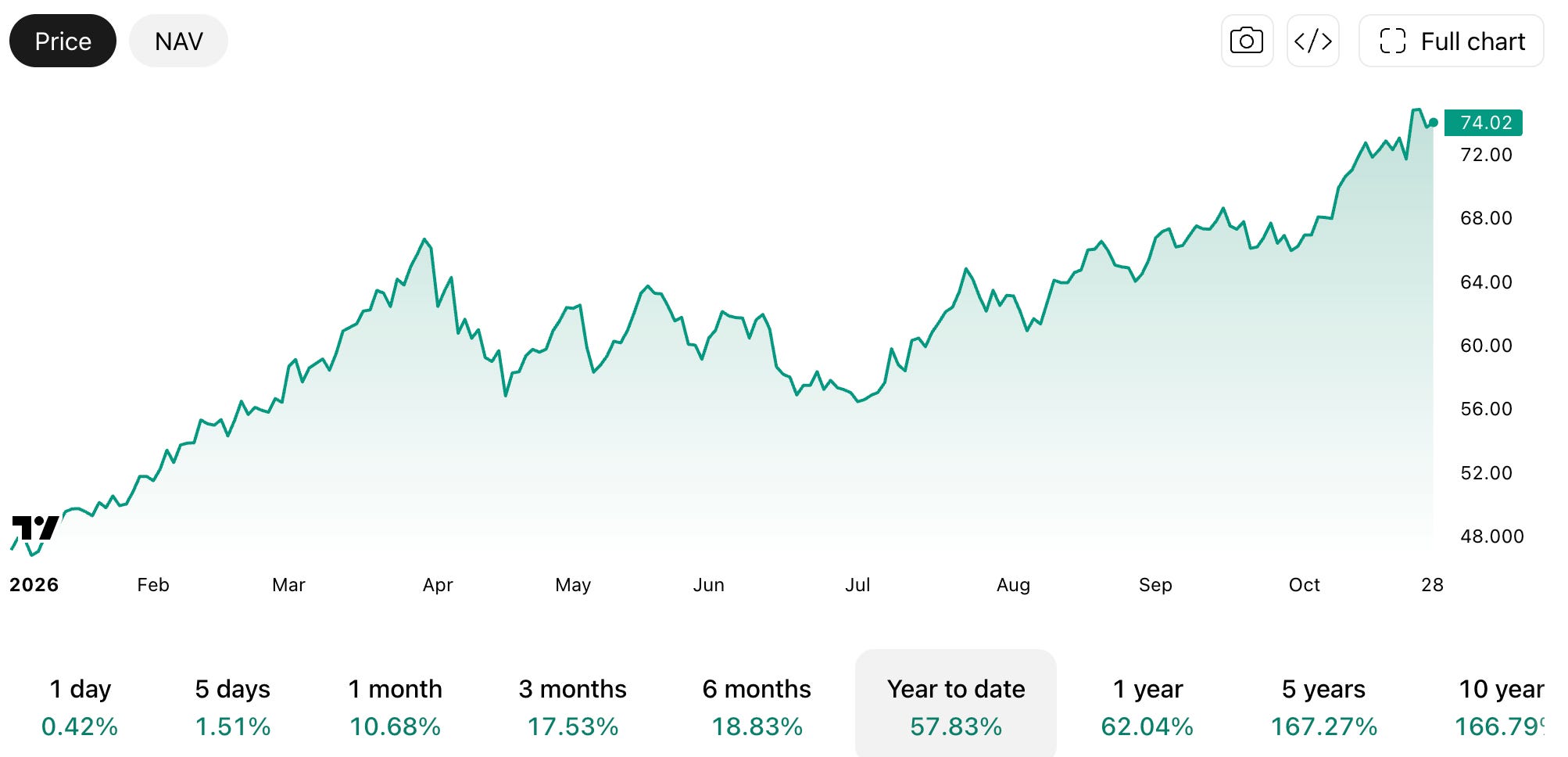
The energy sector is up 57.83% YTD vs. 18% for the MSCI World ACWI in EUR terms. The fund initiated its position in the energy sector on the Jan 26 rebalance; since then, the position is up +43%.
I screen for trades that have an asymmetric return profile and are fundamentally uncorrelated to broad equity/fixed income indices. This position clearly had both.
At the time, the market was assigning a very low probability of nuclear talks escalating, creating the asymmetric risk/reward setup.
Brent was trading at $70, while the U.S. was moving Carrier Strike Group 3 into the region. If the U.S. was looking for a diplomatic resolution, why would they be making this preemptive movement?
Fast forward to today, and it is clear that the U.S. and Israel are fighting for an Iranian regime change, but at what cost? Is this risk fully priced in, or is there further upside on energy equities? If so, how much?
I will attempt to answer these questions in the sections below.