

Legal Disclaimer: Past performance does not guarantee future results, which may vary. The economic and market forecasts presented herein are for informational purposes as of the date of this presentation. There can be no assurance that the forecasts will be achieved. Copyright 2026 Alpha Rho Technologies LLC. All rights reserved.
Introduction
Thirty of the world's best investors just published their holdings. In this note I break down what Soros, Druckenmiller, Dalio, Ackman and 27 others are buying, and which themes they are quietly exiting.
Subscribers can download a PDF report containing:
Statistical summary of all super investor holdings
Portfolio details for every manager analyzed in this research note. Including their options positions.
Report content preview:

Bottom line
Super investors are still buying the AI capex cycle; but the quarterly signal is broadening, not concentration.
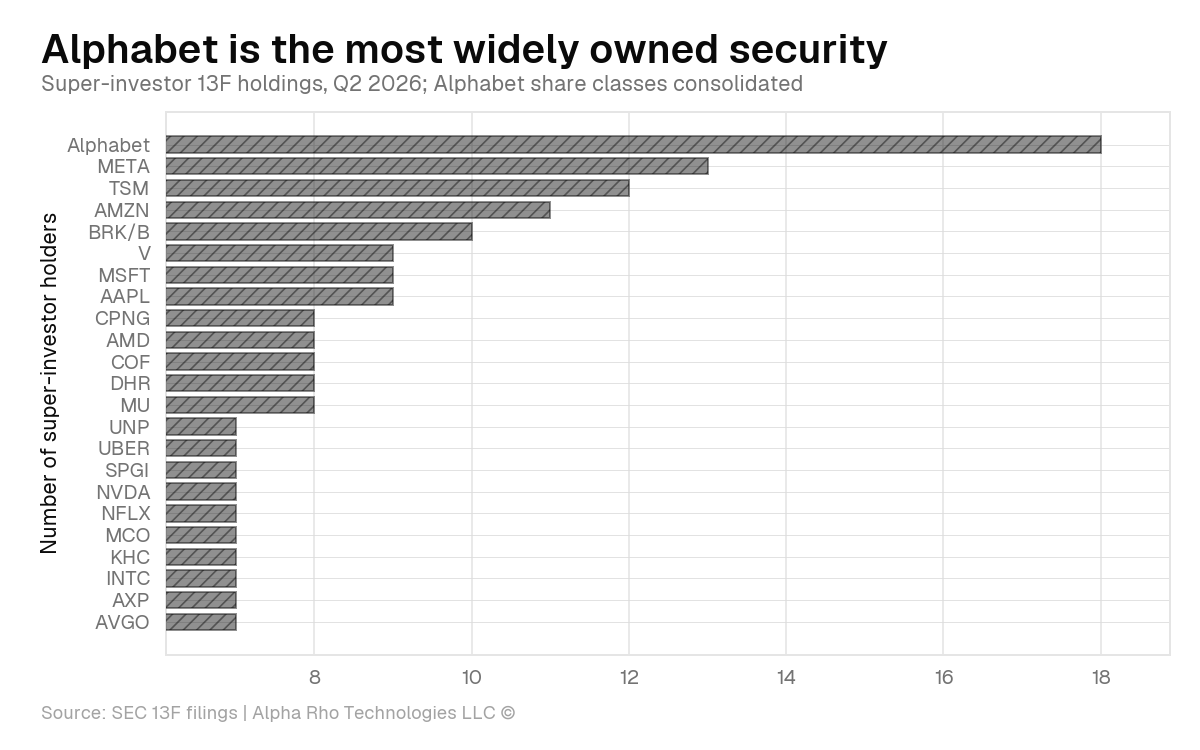
Nvidia’s ownership breadth fell while aggregate semiconductor ownership surged. Capital rotated out of the most crowded megacap beneficiaries and into the less crowded layer that sustains the cycle: memory, foundries, equipment, processors and power infrastructure.
Internationally, the same discipline holds. No broad emerging-market beta; exposure is concentrated in Taiwanese semiconductors, European industrial technology and selected Korean platforms.
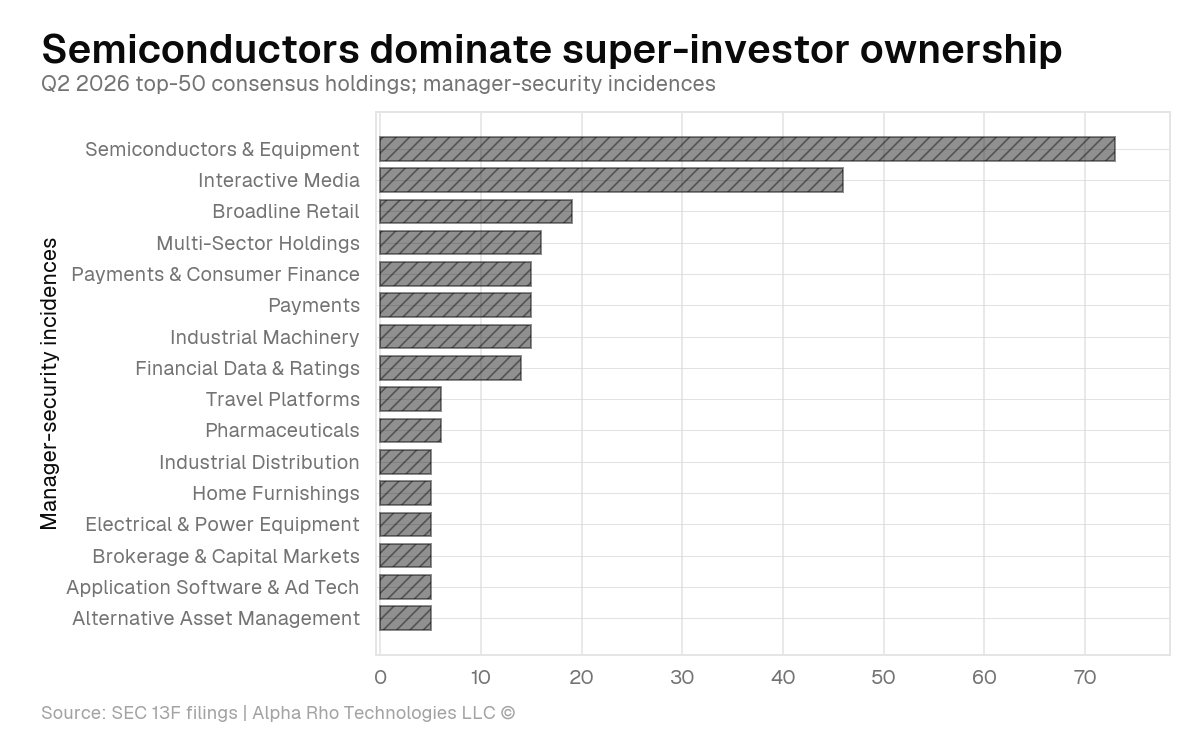
The underlying macro bet is continued nominal growth, supported by AI investment, infrastructure spending and aerospace demand.
This is not recession positioning.
Narratives being bought
AI bottlenecks over AI wrappers
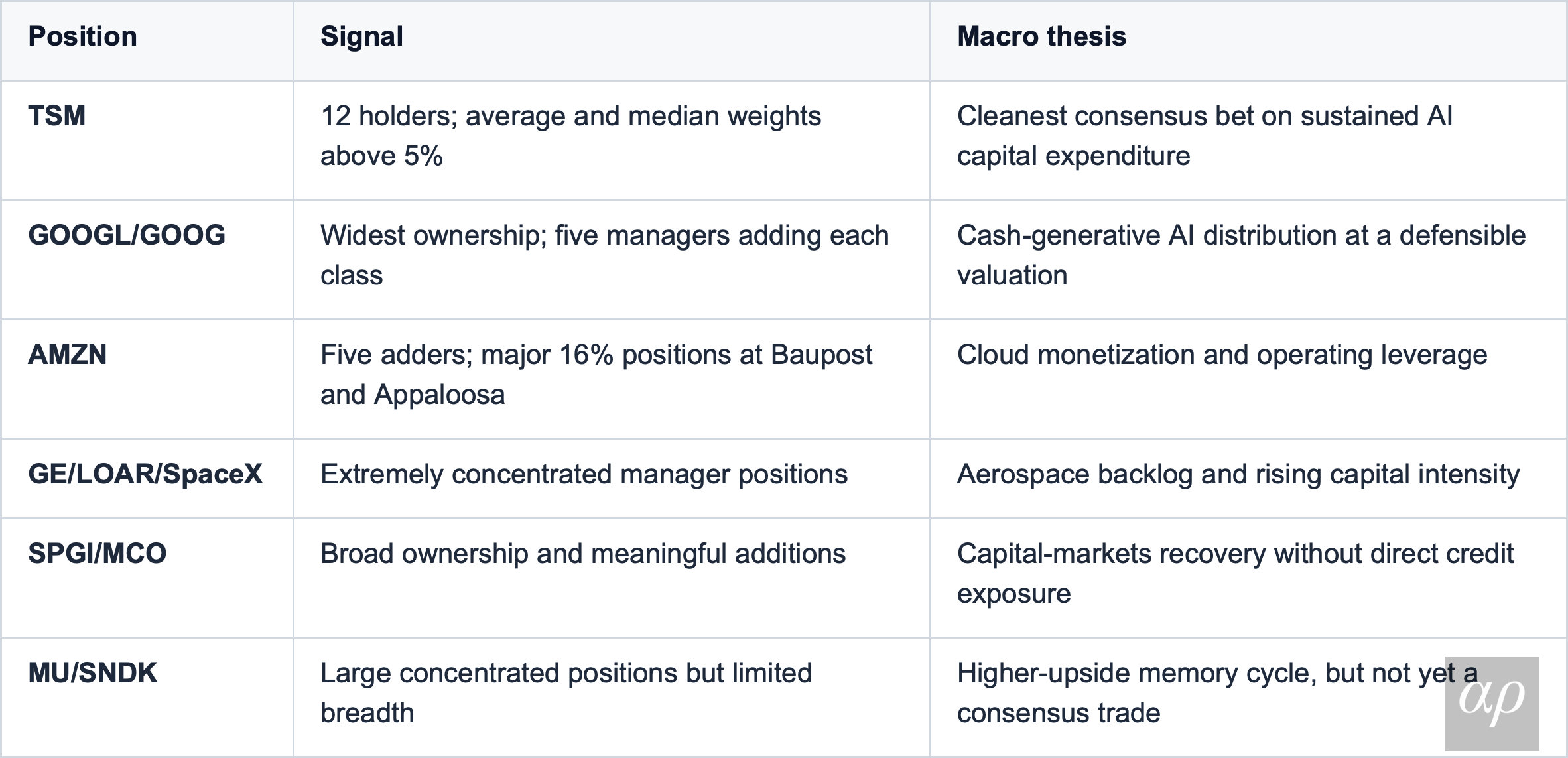
Taiwan Semiconductor is the cleanest consensus position. Ownership increased from nine managers a year ago to 12, while its average portfolio weight rose from 3.3% to 5.4%. The median weight is also 5.5%, confirming that conviction is broad rather than driven by one oversized position.
The trade is expanding across the supply chain. Intel attracted five new buyers, while Cerebras and AMD attracted four each. Lam Research ownership increased year over year, with Applied Materials, ASML and Micron also appearing prominently.
The market is pricing AI as a software and model story. These filings are positioning for the more durable constraint: compute capacity, advanced manufacturing and memory bandwidth.
Alphabet and Amazon remain the preferred platforms
Alphabet is the category’s most widely owned company: 16 managers hold GOOGL and 11 hold GOOG. Five managers increased each share class during the quarter, while GOOGL’s average portfolio weight reached 6.1%.
Amazon was increased by five managers, with a median share-count increase of 20%. Baupost and Appaloosa each allocated roughly 16% of their disclosed portfolios to the company.
This is not blanket mega-cap buying. Super investors are concentrating on platforms with distribution, recurring cash generation and visible AI monetization rather than paying indiscriminately for the technology narrative.
Aerospace and physical capital are becoming structural trades
Five managers initiated positions in SpaceX, representing approximately $3.3 billion of reported value. Abrams allocated 47% of its portfolio to Loar Holdings, while TCI’s GE Aerospace position reached 33.6%.
The same pattern appears in construction materials. Five managers increased CRH, with a median share increase of 46.6%, while Vulcan Materials attracted new buyers.
This is a bet on aerospace backlogs, infrastructure replacement and rising capital intensity. If investment moves from digital promises into physical capacity, these businesses capture the operating leverage.
Financial toll roads over balance-sheet risk
Five managers increased S&P Global, with a median share increase of 42%. Moody’s, Visa and Mastercard also remain widely held, high-weight positions.
The preference is clear: own the data, ratings and payment infrastructure attached to nominal economic activity rather than underwriting the credit cycle directly.
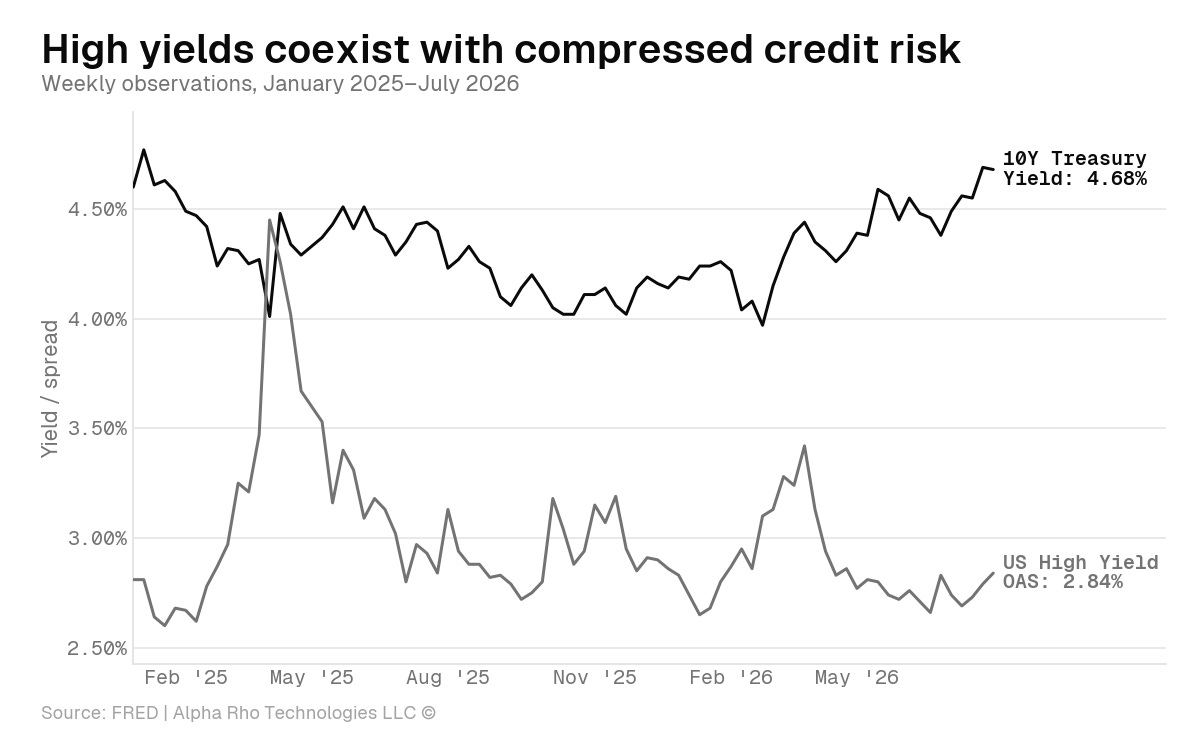
These companies compound through transaction volumes, debt issuance and pricing power without carrying equivalent balance-sheet risk through historically low credit spreads.
Narratives being sold
Crowded mega-cap software
Microsoft experienced the sharpest de-crowding. Ownership fell from 14 managers a year ago to nine, while its average portfolio weight dropped from 6.1% to 1.6%.
Meta’s average weight declined from 6.0% to 2.6% year over year. Broadcom also saw its average weight fall from 5.5% to 1.6%.
Managed care and regulatory exposure
UnitedHealth ownership fell from nine managers to six, while its average weight declined from 3.2% to 0.9%.
At the same time, managers increased Danaher and initiated Zoetis positions. Healthcare exposure is shifting away from reimbursement and political risk toward tools, diagnostics and recurring consumables.
Private-market beta
KKR ownership declined from eight managers to five year over year. Super investors appear less willing to underwrite private-credit and asset-valuation risk at current prices.
High-conviction plays to watch
Methodology: Purchases are based on reported share-count changes and new positions. Reductions are identified through changes in manager breadth and portfolio weights. Form 13F covers US-listed long positions and excludes cash, shorts and most derivatives; the data is reported with a delay of up to 45 days.
Many thanks! I was just about to navigate through Dataroma and Whale Wisdom, and this does certainly save up a lot of time.
One thing to improve the report would be to probably investigate what the "approximate returns" of these hedge funds would be using a tool like the Whale Wisdom backtester, and compare performance & structure to take it to the next level. Nonetheless, great report! Gracias crack!